
Colombo → Sigiriya → Kandy → Ella
Example · Sigiriya, Kandy and Ella — 7 Days with a Local Guide
7 days · 6 nightsEnglish, German
For your datesand your group
Check trip priceWhat to know before you go.
Researched by Sarisara, with sources.
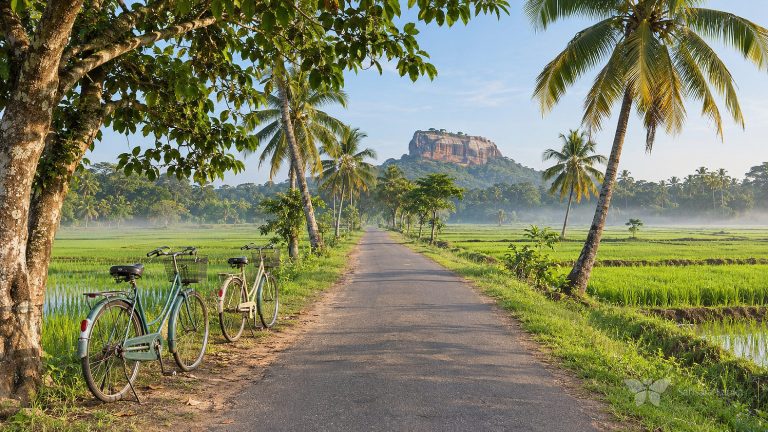
Sigiriya is a huge column of granite rock rising straight up from the flat plains of central Sri Lanka. In the 5th century, King Kashyapa built a palace on top of it and used the rock itself as part of his defences, between the years 477 and 495 CE. After his death the site passed to Buddhist monks for a time, and later fell into the forest, until it was found again by explorers in the 1800s.
Two things make Sigiriya famous beyond its size. The first is a set of painted women on the western rock face, called the frescoes, dating back about 1,500 years — most have faded or crumbled away, but the surviving ones are among the oldest paintings in Sri Lanka. The second is the Mirror Wall, a stretch of wall once polished so smooth that visitors a thousand years ago scratched short poems into it about the frescoes; hundreds of these old poems survive today.
At the base of the rock, three types of garden spread out: water gardens with working fountains, boulder gardens that use huge natural rocks as walls and paths, and terraced gardens climbing the lower slope. Partway up, visitors pass through the Lion Gate — two giant carved paws are all that remain of what was once a full lion’s head and body — which gives the rock its other name, Lion Rock.
UNESCO listed Sigiriya as a World Heritage Site in 1982, calling it one of the best-preserved examples of ancient city planning anywhere in the world. Climbing to the summit means about 1,200 steps in total, ending in a steep metal staircase bolted to the rock face. At the top, only the stone foundations of the old palace remain, but the view over the surrounding jungle and nearby Pidurangala rock makes the climb worthwhile for most visitors.
Entrance tickets are not included in Sarisara prices. Please pay them in cash at the gate.
Last checked: 21 Oct 2026. Prices are set by the temple and can change.
From the Central Cultural Fund's own price list (ccf.gov.lk, read 20 Oct 2026). This is not included in your Sarisara price — it is paid at the gate, in Sri Lankan rupees at that day's exchange rate, or by card. The child price is not confirmed — two independent sources give different figures — so your guide will confirm it with you before the day.
Sigiriya is not a religious site, so there is no dress rule, but wear light clothes and proper shoes for the climb.
Not dressed right? There is no dress check at the gate because Sigiriya is not a religious site. But the final metal staircase is steep, sometimes with a drop to one side, and no shoe-rental stall at the entrance is confirmed, so arrive in proper shoes rather than relying on finding something there.
Independent travel guides do not fully agree on the exact opening and last-entry times. No official hours page from the Central Cultural Fund was found for this specific site, so confirm the time with your guide and treat the gate's posted hours on the day as the ones that count.
Central Cultural Fund (Government of Sri Lanka) Official website
Sigiriya, Matale District, Sri Lanka
Trips, experiences and stays in and around Sigiriya.
Trips
Colombo → Sigiriya → Kandy → Ella
Experiences
Stays
It means “may you live long”. It is how we say hello in Sinhala, and how we greet you every time you come back.
One free account keeps your trips, your saved places and your messages with your guide in one place.
Fire dancers light the road before the elephants of the Esala Perahera.