
Colombo → Sigiriya → Kandy → Ella
Example · Sigiriya, Kandy and Ella — 7 Days with a Local Guide
7 days · 6 nightsEnglish, German
For your datesand your group
Check trip priceWhat to know before you go.
Researched by Sarisara, with sources.
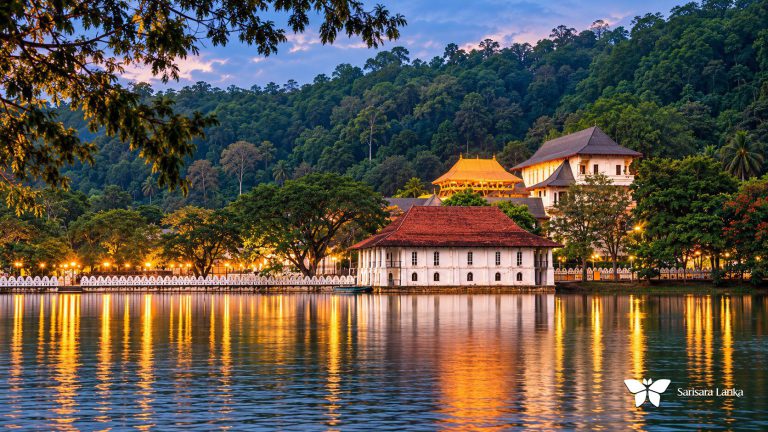
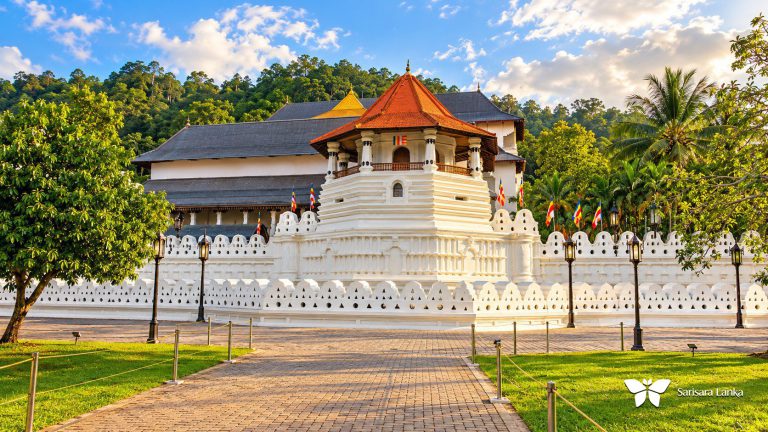
The Kandy Esala Perahera is Sri Lanka’s best-known procession festival, held every July and August to honour the Sacred Tooth Relic of the Buddha, kept inside the Temple of the Sacred Tooth Relic (Sri Dalada Maligawa) in Kandy. The tradition of carrying the relic in procession is more than 1,500 years old. The modern festival is really two processions joined together: the Esala Perahera, which honours four guardian deities (Natha, Vishnu, Kataragama and Pattini) at their own shrines, and the Dalada Perahera, which carries a replica casket of the Tooth Relic itself.
The festival opens with the Kap Situveema, a ceremony where a sanctified young jackfruit tree is cut and planted at the four shrines. Five nights of smaller Devale processions follow, then five nights of the larger Kumbal Perahera with drummers, musicians, flag bearers, whip-crackers and fireball acrobats who clear the road ahead of the procession. After that comes the Randoli Perahera, grander again, with the golden palanquins once used to carry the queens of the old Kandyan kings. A specially trained tusker elephant, the Maligawa Tusker, carries the ceremonial casket under a tall, lit canopy, flanked by whip-crackers, drummers, dancers in traditional costume and other decorated elephants. Fire dances, whip dances and Kavadi peacock dances, brought from the Kataragama tradition, are part of the spectacle.
The whole cycle finishes with the Diya Kepeema, a water-cutting ceremony at the Mahaweli River at Getambe, followed by a Day Perahera the next morning. Dates move every year because they follow the lunar calendar, with the final processions usually landing on a full moon (Poya) day in July or August. The festival is organised by the Diyawadana Nilame, the temple’s chief lay custodian, together with the Malwatte and Asgiriya monastic chapters and the custodians of the four shrines; afterwards, the Diyawadana Nilame sends a formal letter to the President reporting that the festival was completed safely.
July – August Buddhist
About ten nights of processions (Devale, Kumbal and Randoli stages), usually finishing on a full moon (Poya) day that falls in late July or August; exact dates change every year with the lunar calendar
The exact dates follow the moon and are confirmed each year closer to the time.
Any seat or stand fees are paid locally and are not included in Sarisara prices.
Seat prices, where seats are sold, are not confirmed.
Watching from the street is free. This research did not confirm whether paid stands or seats exist, or their price.
No formal dress code was confirmed for street viewing, but this is a religious procession passing a working temple, so modest dress is the safer choice.
Not dressed right? Not confirmed by this research.
Exact dates are set by temple astrologers each year and change annually.
Diyawadana Nilame (chief lay custodian of the Temple of the Sacred Tooth Relic), with the Malwatte and Asgiriya monastic chapters Official website
Sri Dalada Maligawa, Kandy, Sri Lanka
Trips, experiences and stays in and around Kandy.
Trips
Colombo → Sigiriya → Kandy → Ella
Experiences
Stays
It means “may you live long”. It is how we say hello in Sinhala, and how we greet you every time you come back.
One free account keeps your trips, your saved places and your messages with your guide in one place.
Fire dancers light the road before the elephants of the Esala Perahera.