In short

What to know before you go.

Time needed30 minutes to 1 hour
How easyEasy — flat ground and a short flight of steps, barefoot walking on stone and sand
Best timeEarly morning or late afternoon, when it is cooler and quieter; avoid the middle of the day
EntryTicketed — paid in cash at the gate, not included in your Sarisara price

About this place

Researched by Sarisara, with sources.

About this activity

Inside the Mahamewna Gardens in Anuradhapura stands a tree Buddhists believe is more than 2,300 years old — the oldest tree in the world that anyone planted on a known date. According to the old chronicles, in the 3rd century BC the Buddhist nun Sangamitta carried a cutting from the very tree the Buddha sat under when he became enlightened, in Bodh Gaya, India. King Devanampiyatissa planted that cutting here, on a raised stone terrace, and it has been cared for and worshipped every day since.

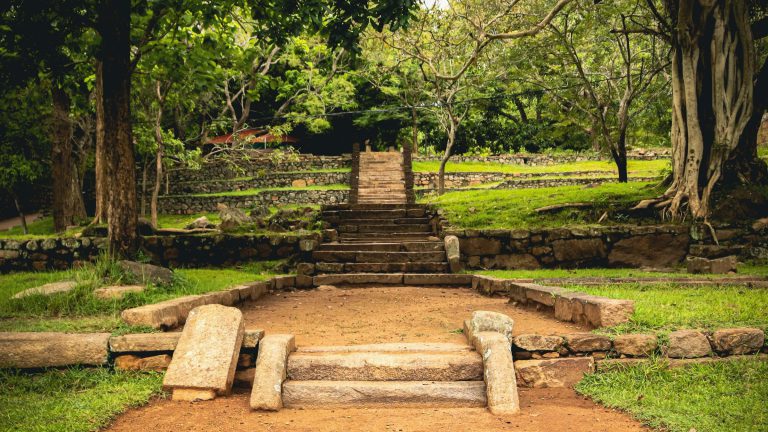
The tree sits on the highest of five terraces, with four lower terraces around it holding its own “children” trees, called Parivara Bodhi. A gold railing protects the trunk, and some branches are held up by gold-plated iron supports so the tree’s own weight does not break them. You cannot walk up onto the top terrace — it is closed off, to protect the tree from damage and from the crowds — but you can stand below and watch pilgrims, many dressed in white, offering flowers, lighting oil lamps and praying quietly.

The whole site forms part of the Sacred City of Anuradhapura, a UNESCO World Heritage Site, and is one of Sri Lanka’s eight most sacred Buddhist places (the Atamasthana). Most visitors spend thirty minutes to an hour here, walking the shaded paths under the Parivara Bodhi trees before or after seeing the two huge white stupas nearby. It is busiest, and most moving, during Poson Poya in June, when Anuradhapura fills with pilgrims marking the day Buddhism first came to Sri Lanka.

Entrance ticket

Entrance tickets are not included in Sarisara prices. Please pay them in cash at the gate.

Ticket price not confirmed — please check at the gate.

The tree shrine has its own small ticket for foreign visitors, separate from the Anuradhapura ticket. Sources do not agree on the price (LKR 200 or LKR 500), so your guide confirms it before the day. It is paid in cash at the gate and is not included in your Sarisara price.

What to wear

Cover your shoulders and knees, and take off your shoes before stepping onto any of the stone terraces.

Wear

  • A top with sleeves that covers your shoulders
  • Trousers, a long skirt, or a long dress that covers your knees
  • Light, loose clothing — there is little shade and it gets hot
  • White is traditional for pilgrims here, but it is not compulsory for visitors
  • Socks, if you do not want to walk fully barefoot on hot stone or sand

Avoid

  • Shorts
  • Short skirts or short dresses
  • Sleeveless tops or vests
  • Swimwear or beachwear
  • Shoes or sandals on any of the terraces

Not dressed for the temple? This is an active, working shrine, not a museum, and the dress rule is expected to be followed at the gate. It is best to arrive already dressed correctly; this research did not confirm whether a wrap or sarong can be borrowed or bought on site, so do not rely on that.

How to behave

Please do

  • Take off your shoes before stepping onto any terrace
  • Keep your voice low and move slowly, the way the pilgrims around you do
  • Let devotees who are praying or making offerings go first
  • Stay on the terraces and paths that are open to visitors
  • Carry your shoes with you or leave them exactly where other visitors have left theirs, near the steps
  • Ask your guide before taking a photo of anyone praying up close

Please do not

  • Do not try to climb onto the top terrace where the tree itself grows — it is closed to protect the tree
  • Do not touch the golden railings, the tree, or offerings left by other people
  • Do not point your feet at the tree or at a Buddha statue when you sit down
  • Do not raise your voice, play music, or run on the terraces
  • Do not bring pets onto the grounds
  • Do not eat, drink, or smoke on the terraces

Allowed and not allowed

Allowed

  • Photography of the tree, terraces and shrine from the areas open to visitors
  • Bringing flowers, incense or oil as an offering, if you would like to make one — it is optional

Not allowed

  • Climbing onto the top (sacred) terrace where the tree itself grows
  • Touching the tree, its golden railings, or its supporting pillars
  • Pets of any kind on the grounds
  • Shoes or sandals worn onto any terrace

What to bring

  • Cash in Sri Lankan rupees for your entrance ticket
  • Socks, if you prefer not to walk fully barefoot on hot stone or sand
  • A light scarf or shawl, in case you need extra cover for your shoulders
  • Water and a hat — much of the walk between terraces is in full sun
  • Flowers, if you would like to make an offering (not required)

Opening times

Opening hours

  • Open every day of the week, About 6:00 AM to 9:00 PM (the ticket counter is reported open 6:00 AM-9:00 PM)

Special days

  • Poson Poya (the full-moon day in June) is the most important day associated with this tree — it marks when Buddhism first reached Sri Lanka, and the site is at its busiest, with pilgrims in white, lanterns and all-night religious activity
  • Vesak (May full moon) and other Poya (monthly full-moon) days bring more local pilgrims than an ordinary day
  • During major festival seasons the terraces and tree are decorated with coloured bunting and extra lighting

Hours are reported consistently by independent travel sources, but this round of research did not find them confirmed on an official government page — please have your guide confirm before a very early or very late visit.

Good to know

  • The sacred top terrace, where the tree itself grows, is fenced off; everyone — Sri Lankan or foreign — views and prays from the terraces below, not from beside the tree
  • The site is a working shrine with a slow, quiet, pilgrimage atmosphere, not a fast-moving tourist stop
  • The shaded paths under the lower Parivara Bodhi trees are noticeably cooler than the open archaeological ruins elsewhere in Anuradhapura
  • The research for this page did not confirm toilet or step-free wheelchair access — ask your guide in advance if this matters for your visit
  • It is usually combined in the same outing as the nearby Ruwanweli Maha Seya and Thuparamaya stupas and the rest of the Anuradhapura Sacred City
  • Expect to walk barefoot on warm stone or sandy ground in the middle of the day; early morning or late afternoon is more comfortable

Who runs this place

The Chief High Priest (Mahanayaka) of the Atamasthana and the Atamasthana Palakasabha (the temple's custodian committee); the wider Sacred City of Anuradhapura is conserved by Sri Lanka's Central Cultural Fund Official website

Where it is

Mahamewna Gardens, Anuradhapura Sacred City, Anuradhapura District, Sri Lanka

In the same area

Trips, experiences and stays in and around Anuradhapura.

Experiences

MayFestival

Anuradhapura · Anuradhapura District

Poson

A Sarisara place
Entry not in trip price
Attraction

Anuradhapura

Ritigala

A Sarisara place
Ticket paid at the gate
Attraction

Anuradhapura · Anuradhapura District

Mihintale

A Sarisara place
Ticket paid at the gate
See everything in Anuradhapura →
Photo credits