In short

What to know before you go.

Time needed20 to 40 minutes from the roadside viewpoint
How easyEasy — viewed from the road or a short, gentle path; suitable for children and elderly visitors
Best timeOctober to December for the fullest flow; morning for clear skies and fewer people, or late afternoon for golden light
EntryFree entry

About this place

Researched by Sarisara, with sources.

About this activity

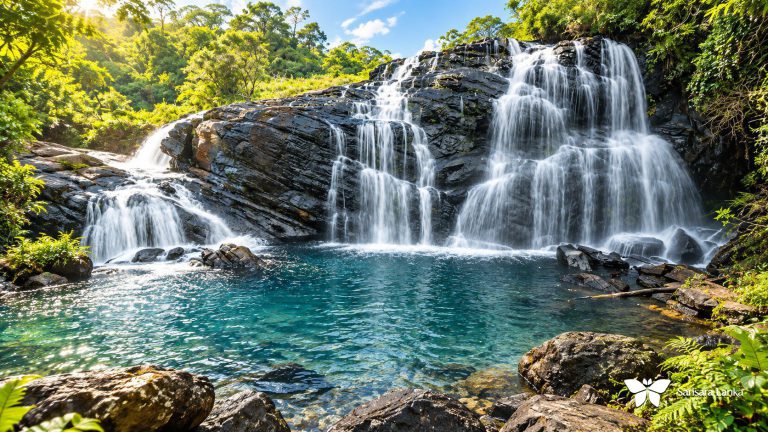
St. Clair’s Falls drops about 80 metres over a wide rock face in the central highlands, close to the town of Talawakele in the Nuwara Eliya District. Its main fall, locally called Maha Ella, spreads around 50 metres wide, with a second, smaller fall further downstream. Because the water spreads so broadly rather than dropping in a single narrow column, it has long been nicknamed the “Little Niagara of Sri Lanka”.

The falls flow from the Kotmale Oya, a river that eventually joins the Mahaweli, Sri Lanka’s longest river. They sit inside tea estate country, with neat rows of tea bushes covering the hills on either side right down to the edge of the gorge. Most visitors see the falls from a roadside viewing area and car park on the Hatton-Talawakele Highway, where the whole width of the cascade is visible across the valley. A short path through the St. Clair Tea Estate leads down for a closer look, passing century-old tea bushes on the way.

The amount of water reaching the falls is partly controlled upstream. The Upper Kotmale Hydropower Project, about 2.2 kilometres above the falls, releases a set volume of water for roughly ten and a half hours a day, between sunrise and sunset, to keep the waterfall flowing for visitors. This means the falls can look noticeably different depending on the time of day you visit.

Swimming in the pools at the base is not allowed, so this is a viewpoint rather than a place to get in the water.

Entrance ticket

Free entry.

There is no entrance ticket for St. Clair's Falls. It is viewed from a public road and car park.

What to wear

Casual clothing, with a light jacket or sweater — this part of the hill country is cool, especially in the morning.

Wear

  • A light jacket or warm layer — Talawakele sits high in the hill country and mornings can be cold
  • Comfortable walking shoes if you take the path down through the tea estate
  • Rain-ready clothing or an umbrella, especially if visiting in the wetter months

Avoid

  • Flip-flops or smooth-soled shoes on the tea estate path, which can be uneven and slippery after rain

Not dressed right? This is a free roadside viewpoint with no dress check, so there is nothing to arrange in advance.

How to behave

Please do

  • View the falls from the roadside car park, or take the short path through the St. Clair Tea Estate for a closer angle
  • Visit in the morning for the clearest skies and fewest people, or near sunset for warm light
  • Arrive before about 9 AM in high season, since the roadside parking area is small and fills quickly
  • Bring a light jacket — the central highlands are noticeably cooler than the coast
  • Keep in mind the waterfall's flow is partly controlled by an upstream hydropower project, so it can look fuller or thinner depending on the time of day

Please do not

  • Do not swim or bathe in the pools at the base — this is not allowed at this site
  • Do not block the narrow roadside parking area for other visitors
  • Do not walk onto tea estate land beyond the marked path without permission — it is a working plantation
  • Do not expect a ticket booth or set opening hours — this is an open roadside viewpoint

Allowed and not allowed

Allowed

  • Photography and video from the roadside viewing area and the tea estate path
  • Walking the short path down through the St. Clair Tea Estate for a closer view

Not allowed

  • Swimming or bathing in the pools at the base of the falls

What to bring

  • A light jacket or sweater
  • Comfortable walking shoes
  • A rain jacket or umbrella in the wetter months
  • A camera — this is one of the most photographed waterfalls in the hill country

Opening times

Opening hours

  • Open every day — this is a free roadside viewpoint with no gate, 24 hours for viewing from the road; the waterfall's own water flow is released by the upstream hydropower project for roughly 10.5 hours a day, between sunrise and sunset

There is no ticket counter or visitor schedule. The one thing that does follow a timetable is the water itself — flow is released from an upstream dam during daylight hours, so very early-morning or night visits may see a thinner waterfall.

Good to know

  • Often called the "Little Niagara of Sri Lanka" for its broad, roughly 50-metre-wide main curtain
  • The water's flow is partly controlled by the Upper Kotmale Hydropower Project 2.2 km upstream, which releases water for about 10.5 hours a day between sunrise and sunset
  • Roadside parking is limited and fills quickly in high season — arriving before about 9 AM helps
  • Swimming or bathing at the base is not allowed
  • A short path through the St. Clair Tea Estate leads closer to the falls, past tea bushes reported to be over a century old
  • Typical visit length is 20 to 40 minutes, and the site is considered easy and family-friendly

Who runs this place

The falls sit within a working tea estate; this research did not independently confirm which tea company manages the land and visitor access

Where it is

Talawakele, Nuwara Eliya District, Sri Lanka (on the Hatton-Talawakele Highway, about 3 km from Talawakele)

In the same area

Trips, experiences and stays in and around Nuwara Eliya.

Experiences

See everything in Nuwara Eliya →
Photo credits