In short

What to know before you go.

Time neededAbout 1 to 1.5 hours for the temple itself
How easyEasy — flat ground, a few steps, barefoot walking indoors
Best timeEarly morning (around 5:30-7:00 AM) for the fewest people, or the evening ceremony (6:30-8:00 PM) for the best atmosphere
EntryTicketed — paid in cash at the gate, not included in your Sarisara price

About this place

Researched by Sarisara, with sources.

About this activity

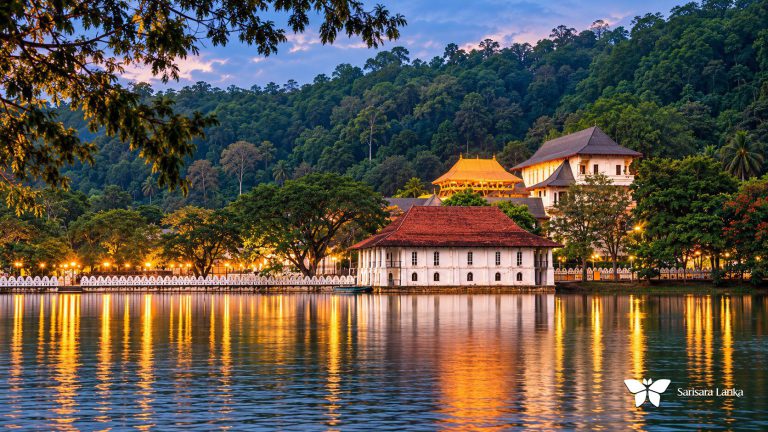
The Temple of the Sacred Tooth Relic sits beside Kandy Lake, in the middle of the city that was the last royal capital of Sri Lanka. Buddhists believe it holds one of the Buddha’s own teeth, carried to Sri Lanka from India in the 4th century. For more than a thousand years, whoever kept this tooth was seen as the rightful ruler of the island, so kings built their palaces right beside it. The temple you see today is part of that old royal palace.

The tooth itself is never shown to visitors. It stays inside a small gold casket, inside a larger gold casket shaped like a bell (a stupa), locked inside an inner room. Three times a day, monks open the doors of that inner room for a worship ceremony, with drums, horns and chanting. You can stand in the hall outside and watch, and on a lucky day the doors stay open long enough to see the outer casket.

The white octagonal tower with the red roof, called the Paththirippuwa, is the building most people photograph — it used to be where the king watched festivals, and is now the temple library. The whole site, together with the old royal palace around it and the city of Kandy, is a UNESCO World Heritage Site, listed in 1988.

Most visitors spend about one to one and a half hours here. It is a living, working temple, not a museum — Buddhist pilgrims come to pray, not to sightsee, so visitors are asked to stay quiet and respectful, especially during a ceremony.

Entrance ticket

Entrance tickets are not included in Sarisara prices. Please pay them in cash at the gate.

  • Foreign visitor (adult)LKR 3,000
  • Visitors from South Asian countries (adult)LKR 2,500

Last checked: 20 Oct 2026. Prices are set by the temple and can change.

From the temple's own website (FAQ, read 20 Oct 2026): the ticket also covers the Dalada Museum, the World Buddhist Museum, the Tusker Museum and the Royal Elephant Stable. Tickets come only from the temple's ticket machines; tickets sold by anyone else are not valid. The South Asian price also applies to visitors from Thailand and Myanmar.

What to wear

Cover your shoulders and knees, and take off your shoes and any hat before you go into the temple buildings.

Wear

  • A top with sleeves that covers your shoulders
  • Trousers, a long skirt, or a long dress that covers your knees
  • Light, loose clothing — it gets warm inside
  • White clothing is traditional and always welcome, but it is not compulsory
  • Socks, if you do not like walking barefoot on warm or wet stone floors

Avoid

  • Shorts
  • Short skirts or short dresses
  • Sleeveless tops or vests
  • Any revealing or see-through clothing
  • Hats or caps inside the buildings

Not dressed for the temple? The dress rule is checked at the entrance. If you arrive in shorts or a sleeveless top, the temple's own guidance says appropriate clothing can be obtained at the entrance, and independent guides report that sarongs and shawls can usually be rented or bought near the gate. It is still better to arrive already dressed correctly, in case nothing is available on a very busy day.

How to behave

Please do

  • Take off your shoes and any hat before entering a temple building
  • Keep your voice low, especially near the inner shrine
  • Walk, do not run, inside the temple grounds
  • Follow the queue and any rope barriers near the inner shrine, especially during a worship ceremony
  • Let monks and devotees doing their prayers go first
  • Keep to the areas visitors are allowed in — some inner rooms are for monks only
  • Carry your shoe-storage token safely until you collect your shoes

Please do not

  • Do not turn your back to a Buddha statue or the shrine to take a selfie
  • Do not point your feet at a Buddha statue when sitting
  • Do not touch monks, statues, or offerings
  • Do not eat or chew gum inside the temple buildings
  • Do not raise your voice or play music
  • Do not bring pets onto the temple grounds — this is clearly not allowed
  • Do not bring food, drink, or offerings in plastic or polythene bags or containers — the temple asks visitors to avoid these

Allowed and not allowed

Allowed

  • Photos in the outer halls and courtyards
  • Walking around the outer temple complex and museums at your own pace

Not allowed

  • Photography and filming of the tooth relic itself and the inner shrine where it is kept
  • Drones — do not fly a drone anywhere near the temple; this is a high-security site
  • Pets of any kind on the temple grounds
  • Large bags, and anything brought in polythene or plastic bags/containers
  • Photos during the worship ceremony that disturb people praying — be discreet even where photos are otherwise allowed

What to bring

  • Cash in Sri Lankan rupees for your entrance ticket (card payment is not reliable here)
  • Socks, if you prefer not to walk fully barefoot indoors
  • A light scarf or sarong, in case you need extra cover for your shoulders or legs
  • A small, simple bag — large bags must be checked in or left behind
  • Water, especially if visiting in the middle of the day

Opening times

Opening hours

  • Open every day of the week, 5:30 AM to 8:00 PM

Daily worship (puja) times

  • Dawn ceremony: about 5:30 AM - 7:00 AM
  • Midday ceremony: about 9:30 AM - 11:00 AM
  • Evening ceremony: about 6:30 PM - 8:00 PM

Special days

  • Poya days (the full-moon Buddhist holy day, once a month) bring many more local pilgrims and longer queues
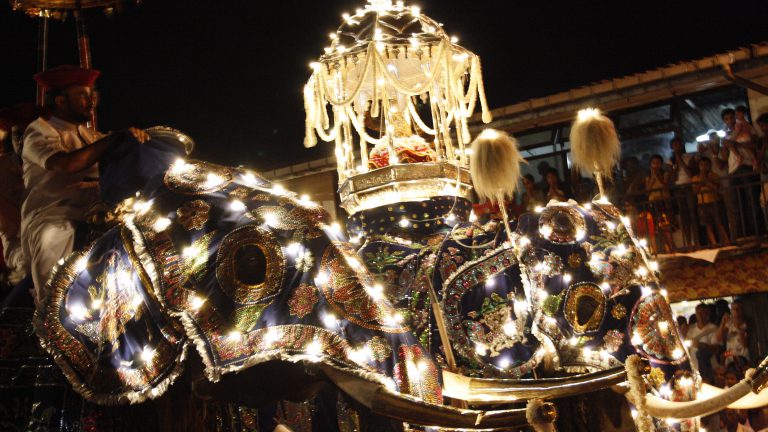
  • The Esala Perahera, a ten-night festival of drummers, dancers and decorated elephants honouring the tooth relic, is held every July or August; the exact dates change every year because they follow the Buddhist lunar calendar, so they are not fixed in this page
  • A special Wednesday ceremony includes a symbolic washing of the relic with scented water and flowers

Hours and puja times are reported consistently across the temple's own site and independent guides. The Esala Perahera dates must be checked closer to the date each year, since they move with the lunar calendar.

Good to know

  • Security is strict: everyone is screened at the entrance and bags and offerings are checked with scanning machines, similar to an airport check. This follows past security incidents at the temple.
  • Shoes and large or non-essential items must be handed in at a reception booth near the entrance in exchange for a token; collect them on your way out
  • Wheelchair users can reach most of the outer complex without stairs, and the temple states a special service for visitors with mobility needs is available, including transport from the main entrance and use of a lift — but independent visitor reports say the toilet is too narrow for a wheelchair and some inner areas are hard to reach, so people with limited mobility should contact the temple in advance if possible (phone 0812234226, per the temple's own site)
  • Expect a queue at busy times, especially the evening puja and on Poya days — arriving 20-30 minutes before a ceremony starts gets you a better spot
  • The dawn ceremony is usually the quietest, with the fewest visitors
  • The site includes several small museums inside the complex as part of the same ticket

Who runs this place

Diyawadana Nilame (the temple's lay custodian) and the Sri Dalada Maligawa Trust, with the Malwatta and Asgiriya monastic chapters conducting the daily worship Official website

Where it is

Sri Dalada Veediya, Kandy, Sri Lanka

In the same area

Trips, experiences and stays in and around Kandy.

Trips

Experiences

June to JulyFestival

Kandy · Kandy District

Kandy Esala Perahera

A Sarisara place
Entry not in trip price
Attraction

Kandy · Kandy District

Kandy Lake

A Sarisara place
Free entry

Stays

See everything in Kandy →
Photo credits
  • Photo 1: Temple of the Tooth in Sri Lanka — Sarisara Lanka
  • Photo 2: Elephants in Kandy’s night procession — Sarisara Lanka
  • Photo 3: Golden floral passage to the shrine — Sarisara Lanka
  • Photo 4: Kandy's Temple of the Tooth — Sarisara Lanka
  • Photo 5: Kandy’s Temple of the Tooth at Dusk — Sarisara Lanka
  • Photo 6: Ornate Temple of the Tooth shrine — Sarisara Lanka
  • Photo 7: Sri Lankan ceremonial elephant mural — Sarisara Lanka